
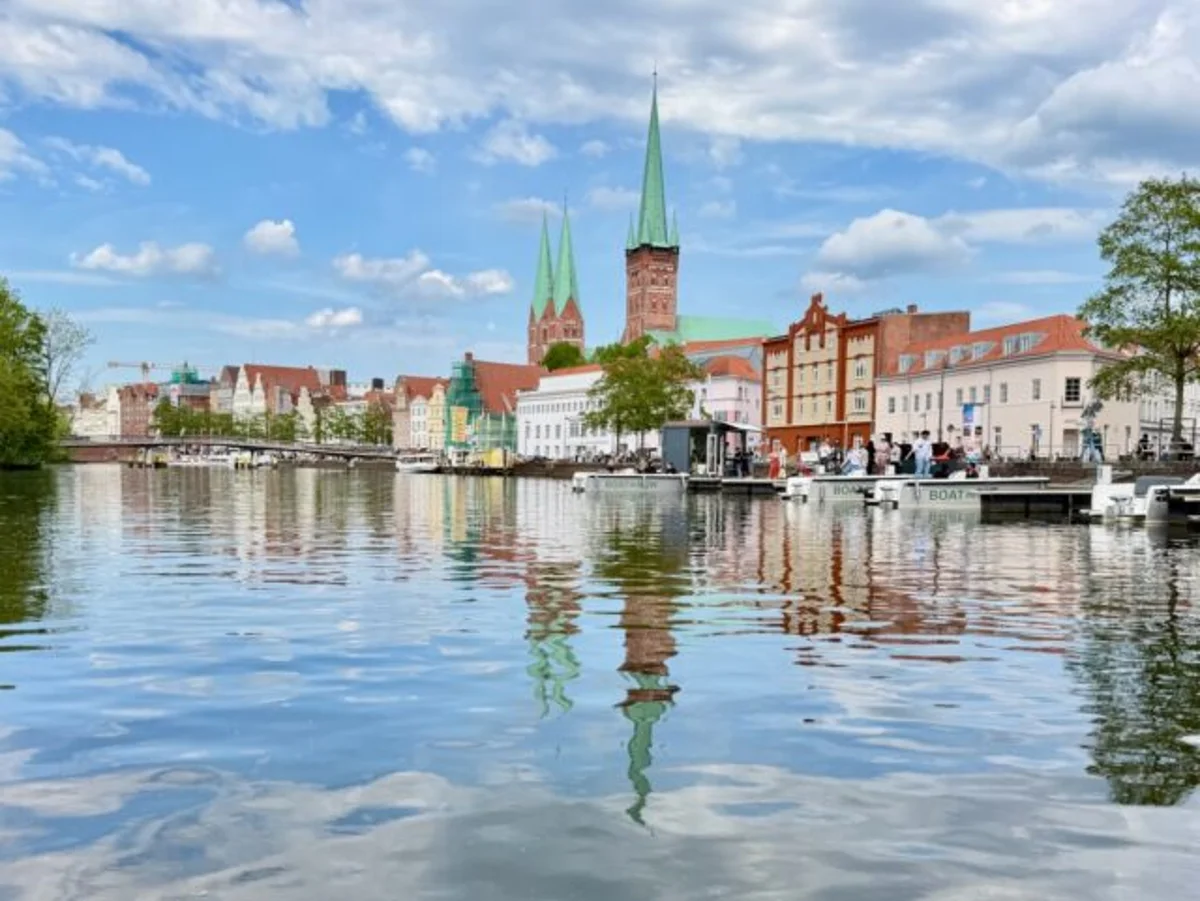
The station was nearly empty when my train to Lübeck pulled out of Hamburg. Less than an hour later I was staring at a skyline of church spires and terracotta roofs, and I understood, finally, why I keep choosing trains over cars. No traffic, no parking, no fighting for a space in a full city centre — just the window seat, the notebook, and whatever the next town decides to show you.
This was an eight-day loop through the north and a slice of the east: Lübeck, Rostock (with a day out to Warnemünde), Erfurt, and Potsdam. Hamburg and Bremen get most of the attention, but this route is the deeper story — Hanseatic merchants first, then Baltic seafarers, medieval Thuringia, and finally the Prussian kings. Four of these cities belong to Historic Highlights of Germany, a program of 17 heritage cities, usually university towns with a rich historical legacy and a lively cultural and culinary scene. One more thing they share: every one of them is easy to explore on foot.
Here’s the shape of the trip, in case you want to copy it:
- Day 1 — Lübeck (1 night)
- Day 2 — train to Rostock in the late afternoon (2 nights)
- Day 4 — morning train to Erfurt via Berlin (2 nights)
- Day 6 — morning train to Potsdam via Berlin (2 nights)
The cities reward a slow pace, so I left buffer days built in. If you’re shorter on time, drop one city rather than rushing the rest — that’s the lesson this route teaches you, whether you plan it or not.
Lübeck: the queen of the Hanseatic League
The first glimpse of Lübeck stayed with me. Its old town sits on an island in the Trave River, and from the water the spires and gabled houses read like a painting that somehow also functions as a city. It was one of the wealthiest trading centres in medieval Europe, and the UNESCO World Heritage old town has been painstakingly restored after WWII.
I started the day the lazy way: an hour-long cruise around the old town on a small e-boat I piloted myself. The views of the town and its green parks from water level are the best in the city, hands down. You can hire an e-boat at BoatNow or join a regular Trave River cruise.
After that I switched to the way this city actually wants to be explored: on foot, slowly, getting a little lost. The old town rewards exactly that. Narrow alleyways called Gänge branch off unexpectedly from the wider streets, opening into hidden courtyards, tiny houses and flower-filled passages. Around nearly every corner stands another example of Brick Gothic architecture, the style that defines much of northern Germany. I spent an entire afternoon hunting for gänge — Bäcker Gang, Hellgrüner Gang, Durchgang, Höveln Gang — and it never got old.
The landmarks, for the record:
- Holstentor — the monumental twin-towered city gate, built in the 15th century, whose brick façade once defended one of Europe’s wealthiest ports. It has become the image of Lübeck itself.
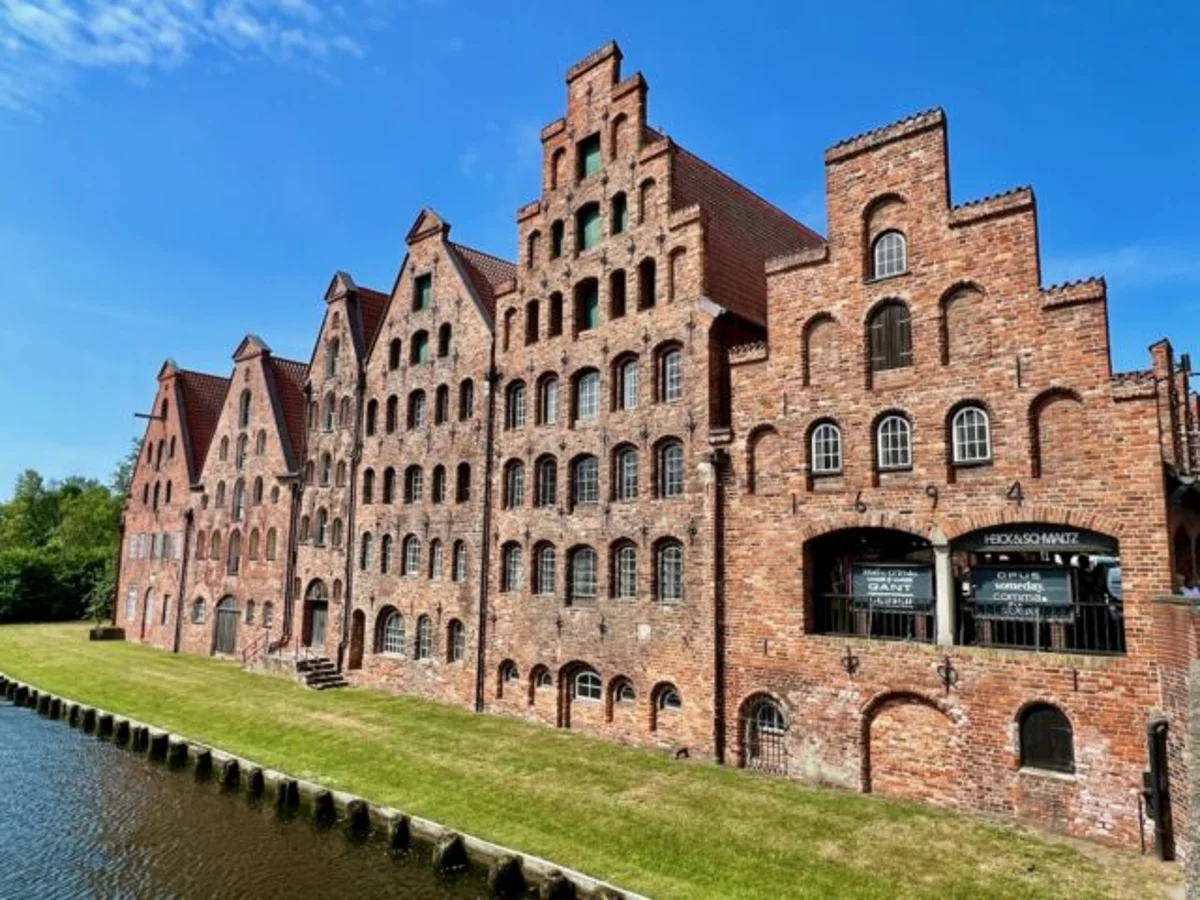
- Salzspeicher — a row of six historic warehouses on the Trave, the oldest from 1579, the newest from 1745, used to store salt brought from Lüneburg before it was shipped across Europe.
- St. Peter’s Church — climb the tower for one of the best views in the city; from above Lübeck is a sea of terracotta roofs punctuated by spires and waterways.
- The old City Hall — a 13th-century architectural masterpiece with elegant arches and towering spires.
- St. Mary’s Church — a 14th-century Gothic masterpiece; its soaring nave inspired church builders across the Baltic region, and the atmosphere inside is grand and quietly contemplative.
- The Hansemuseum — dedicated to the Hanseatic League, the association of merchant cities that dominated medieval trade in northern Europe.
And because the city is famous for marzipan, I did what anyone does: stopped at the historic Niederegger shop across from the City Hall, then had coffee and a slice of cake in the café upstairs. The promenade An der Obertrave, lined with medieval and Renaissance houses and packed with cafés in the warmer months, is where you end the day with a slow walk along the water.
For dinner, the maritime heritage shows up on the menu: fresh fish, creamy seafood soups, northern classics. Just across from Jakobikirche I found one of Lübeck’s oldest and most iconic restaurants, Schiffergesellschaft — atmospheric, historic, and worth a table.
Stay: I stayed at Hotel LIHO, a family-owned hotel roughly between the station and the old town. Comfortable rooms (the minibar is included in the price), an abundant breakfast, and a quiet coffee corner I loved. If you’d rather be in the heart of the old town near St. Peter’s, Atlantic Hotel Lübeck is a modern, luxurious option.
Rostock: a maritime city with a broad palette
From Lübeck, the train east to Rostock rolls through forests, fields and scattered villages before reaching one of Germany’s most important Baltic ports. Rostock wears its maritime identity proudly — centuries of seafaring tradition appear everywhere you look. It was a powerful medieval port and the largest in East Germany during the GDR period, and the architecture keeps the layers intact.
It was raining when I arrived, and the city was no less beautiful for it. Rostock is easy to walk — the highlights below take comfortably half a day, and the route flows naturally: start at St. Peter’s Church, follow the old city wall, then cross the old town towards the harbour.
- St. Peter’s Church — the 13th-century church is the city’s oldest; its 117-metre tower, restored in 1994 with contributions from the public, is visible from miles away.
- Steintor — the 16th-century Stone Gate in Dutch Renaissance style, an elegant tower guarded by griffin sculptures, built where the medieval fortifications stood.
- Neuer Markt — the historic heart of the city: a square lined with colourful gabled buildings, dominated by the Town Hall. Originally a 13th-century Brick Gothic building, it gained a pink Baroque façade in the 18th century — a small history lesson in one street corner.
- St. Mary’s Church — the largest of Rostock’s three medieval churches, home to one of northern Europe’s oldest astronomical clocks, still functioning after more than five centuries, and one of the largest single stained-glass windows in Europe.
- Kröpelinerstrasse — the lively pedestrian street of boutiques, cafés and fragments of medieval and Renaissance architecture. Look up; that’s where the street’s real character lives.
- Universitätsplatz — the street ends at the university square, with its ‘Zest for Life’ fountain. The University of Rostock, founded in 1419, is one of the oldest in Germany. A stone’s throw away, the Cultural History Museum sits in a 13th-century monastery.
- Langestrasse — built during the GDR period for Soviet-style parades, this broad boulevard is a genuinely fascinating blend of 1950s socialist-classicist façades and Brick Gothic references to the Hanseatic past. Behind it, on Wokrenterstrasse, stands the Hausbaumhaus, one of the oldest and best-preserved merchant houses from the Hanseatic era.
I ended the walking tour at the harbour in time for the 2:30pm cruise to Warnemünde on the Rostocker 7. I’d been in and out of the city for a while by then, so I was honestly surprised at how much this half-day still gave back. Rostock’s evenings are lively but relaxed — shaped, in part, by the university crowd — and I ended the day at the harbour watching the sun drop below the horizon.
Stay: ScanHotels Stadthafen, at the harbour on the fringe of the old town. Modern interior, a large gym, a rooftop spa, and a genuinely wonderful bed. Breakfast was fantastic, and next door, Gasthaus Unser Bier serves solid German food and beer.
Warnemünde: where the clouds gave way
It was cloudy and grey in Rostock, and by the time the boat neared the coast the sky had opened completely. Warnemünde has an easygoing coastal charm that felt like a different country: fishing vessels in the harbour, cafés spilling onto promenades, locals strolling the waterfront with freshly smoked fish sandwiches.
The first stop is obvious. The Alter Strom is an inner harbour lined on both sides with cafés, restaurants, shops and fishermen’s boats — and the fish counters where you order a fischbrötchen, the fish sandwich that is the whole point of being here. Order one, eat it standing on the promenade, watch the boats come in. It just works.
Other things I loved on that day out:
- The old fishermen’s houses on Am Strom — one of them was occupied by Edvard Munch during his stay in Warnemünde, and it’s now a small museum dedicated to the artist.
- Alexandrinenstrasse — a shady, quiet street filled with genuinely beautiful houses; perhaps the most charming street in Warnemünde.
- The lighthouse and the tea-pot-shaped building next to it, beloved local symbols. The climb rewards you with sweeping views over the harbour entrance, the beaches and the Baltic. One warning, learned the hard way: watch your head on the top section of the spiral staircase, and at the door to the viewing platform.
- The beach itself — one of the widest stretches of sand on the Baltic coast, with the Strandkorb beach chairs that Warnemünde is famous for. Invented in Rostock, first introduced here, now found across the German Baltic coast.
Before the boat back, I had a fish dinner at Restaurant Seekiste zur Krim on Am Strom. It was the right ending to the right kind of day.
Erfurt: medieval intimacy
Heading south, the flat northern landscape gives way to gentler hills and broader plains, and the train arrives in Erfurt, capital of Thuringia. To be honest, Erfurt isn’t strictly northern Germany — I added it because it had been on my wishlist for a long time. Years earlier I’d spent one night there during a tour of Thuringia and Saxony, arrived almost in the dark, and fallen for the city on that single evening stroll. This was the promised return.
The difference is immediate. Lübeck speaks of merchant wealth and Rostock of maritime life; Erfurt radiates medieval intimacy. Spared the destruction of WWII, its old town is remarkably preserved — timber-framed houses, cobblestone lanes, atmospheric squares, and a UNESCO World Heritage listing that feels earned rather than decorative.
I spent two days crisscrossing the old town. The highlights:
- Domplatz — the focal point of the city. Overlooked by the 15th-century Erfurt Cathedral and St. Severus Church on a broad staircase, it’s the kind of square that makes you stop mid-sentence.
- Erfurt Cathedral — a 14th-century Gothic cathedral with towering nave and spires, beautiful stained glass, and the Gloriosa, considered one of the world’s largest medieval free-swinging bells. Martin Luther was ordained here in 1507.
- Krämerbrücke — the Merchants’ Bridge, one of Europe’s rare inhabited bridges: houses, workshops, galleries and cafés balanced over the water. I remember my first visit, searching for the bridge until I realised I was already on it. Goldhelm Schokolade has a shop on the bridge — a small local business that has grown into an institution, with genuinely excellent chocolate — and a café nearby at Kreuzgasse 5 for coffee, hot chocolate and cake.
- The Augustinian Monastery — where a young Luther entered monastic life; it’s a window onto the formative years of one of Europe’s most influential figures.
- The Old Synagogue — a 12th-century building, one of the oldest in Europe, only uncovered in the 1990s. The exhibition on Jewish Erfurt in the Middle Ages is fascinating, and the collection of gold and silver coins and jewellery mostly dates from the 13th and 14th centuries.
- Petersberg Citadel — a 17th-century star-shaped Baroque fortress on a hill above Domplatz, built on the foundations of a medieval Benedictine monastery and strengthened by Napoleon in the 19th century. Parts of the underground passageways are open, and the views from the walls are worth the climb.
- The former Stasi prison in Andreasstrasse — poignant and inspiring, with stories of oppression and resistance from the GDR era brought vividly to life.
Despite the medieval streetscape, Erfurt never feels like an open-air museum. Markets fill the squares, students gather at cafés, and people are out whenever the weather allows. The food is part of the experience too: a freshly grilled Thüringer Rostbratwurst from a market stall — there’s a well-known one at Domplatz, at the foot of St. Severus — with mustard and a crusty roll is simple, hearty, and practically mandatory. For a slower meal, Zum Güldenen Rade on Marktstrasse is well known for its Thuringian cuisine and local beers.
Stay: Dorint Hotel am Dom, a comfortable business hotel opposite the Erfurt Theatre. If you’d rather have a family-run feel, Hotel Domizil at Domplatz has spacious rooms and a terrific breakfast.
Potsdam: the Prussian finale
Potsdam sits about 30 minutes outside Berlin, and it lands on so many day-trip itineraries that people seem to pass through it in a hurry. It deserves more. Set among parks and roughly 20 lakes, the city has an elegant Baroque centre laid out on a grid, lined with boutiques, restaurants and cafés that give it a relaxed sophistication. Compared with Berlin’s high-octane energy, Potsdam feels like a classy spa retreat — locals sipping wine at terraces, strolling the parks, out on the water. I quickly picked up on the local joie de vivre.
Two days, taken slowly:
- Alter Markt — the grand baroque square of the old town. Its Nikolaikirche, a neoclassical building completed in 1850, has a dome you can climb for panoramic views; the Obelisk in the centre was erected in 1753 to commemorate the city’s builders and architects. The Museum Barberini, a world-class art museum in a reconstruction of the Barberini Palace, is right there.
- Stadtschloss — the former royal residence of the Prussian kings, now the seat of the Brandenburg Parliament. The Corinthian colonnade and the golden angels of the Angel Staircase are the details to look for.
- The Dutch Quarter — 150 neat red-brick buildings from the 18th century, built for Dutch artisans invited to Prussia. Now cafés, boutiques and galleries; wandering it feels unexpectedly cosmopolitan. Zum Vliegende Holländer on Benkertstrasse is a good stop for a meal.
- The Brandenburg Gate — smaller than Berlin’s, and older, as the locals will point out. The adjacent Luisenplatz was hosting a wine festival when I passed, which I did not treat as a coincidence.
- For a view of the whole city, the top of the Garrison Church (there’s an elevator). Nearby, the Potsdam Film Museum covers German cinema history, including the legacy of Babelsberg Studios, the oldest large-scale film studio in the world.
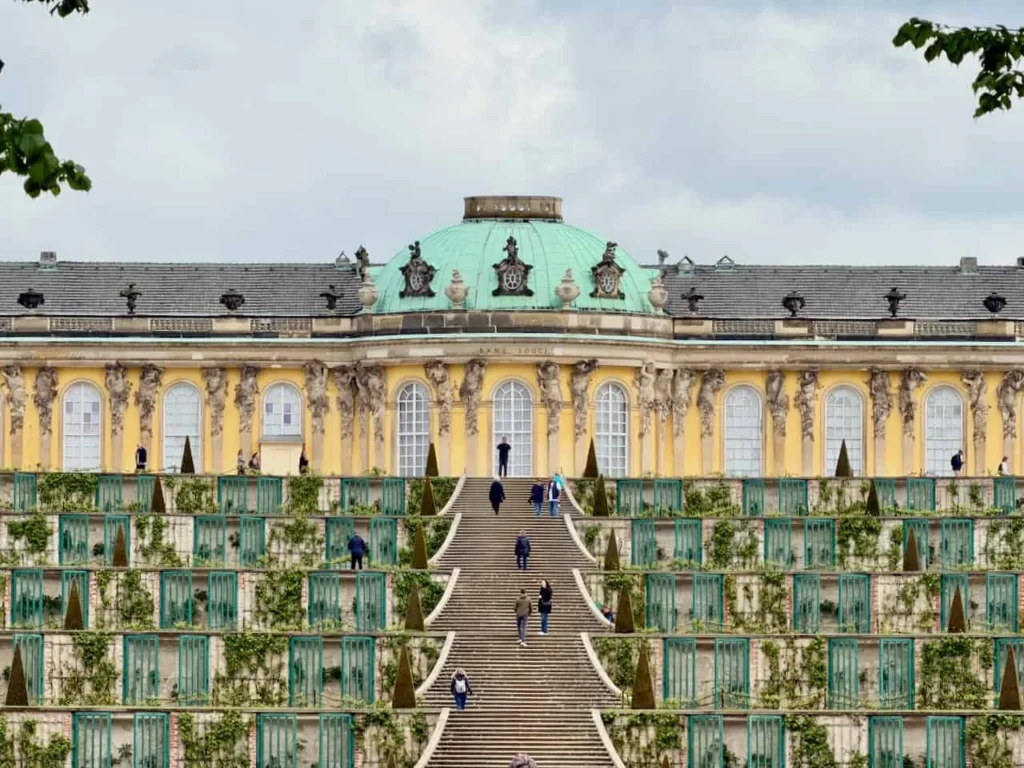
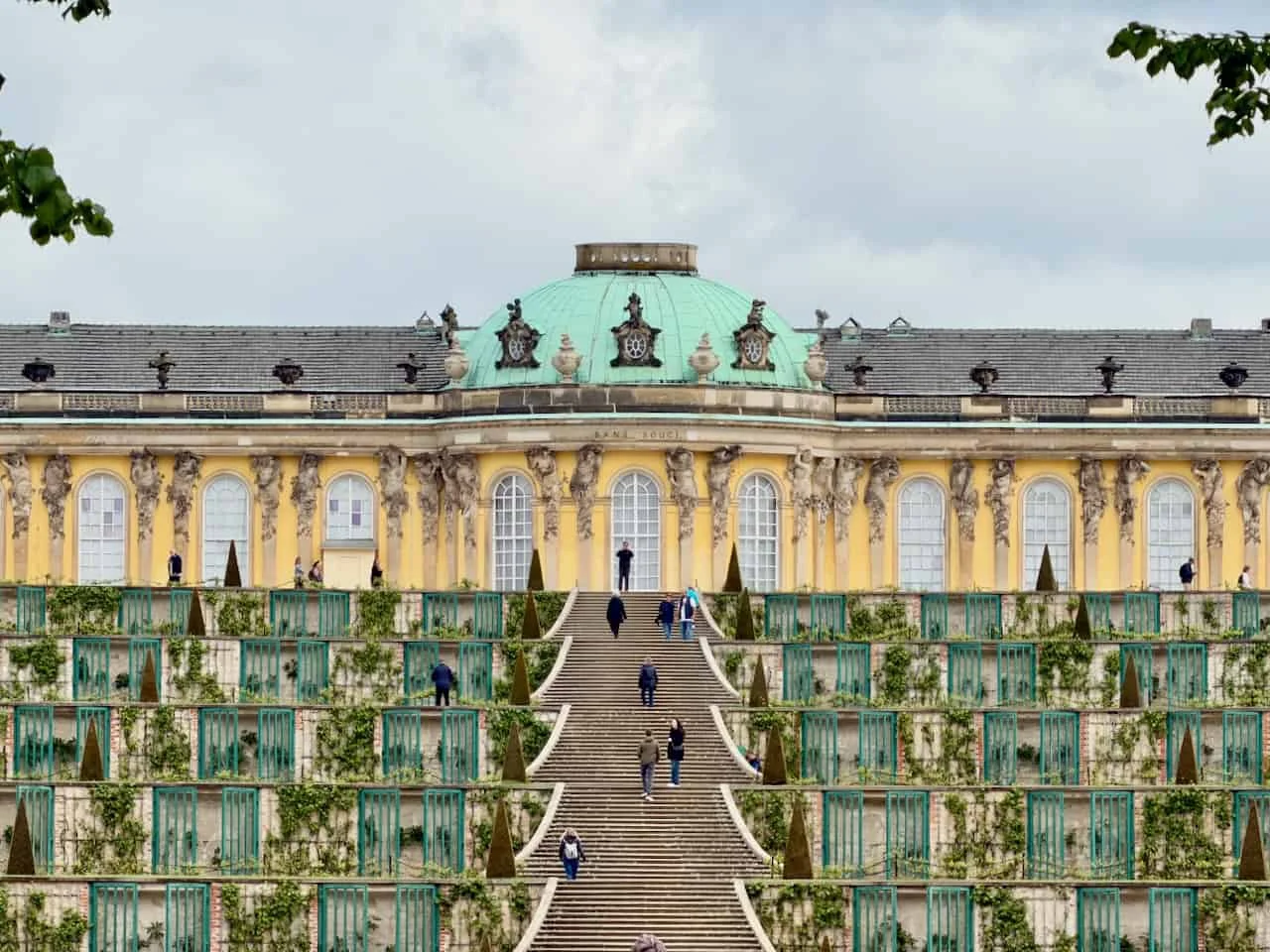
But the crowning glory is Sanssouci — Frederick the Great’s intimate, exquisite Rococo summer residence, set amid terraced vineyards and gardens. Arrive by 10am, before the crowds gather, and the palace tour is far more relaxing. The gardens are immense: fountains, sculpted paths, temples and hidden viewpoints. You could easily spend an entire day on the park alone. Don’t skip the Chinese House, with its gilded Rococo detailing and idyllic setting — a fascinating glimpse into 18th-century Europe’s fascination with Asian art. And the New Palace, the last great Prussian Baroque palace, is the full opposite of intimate: lavishly decorated state rooms, grand halls, a Grotto Hall encrusted with seashells, minerals and fossils, and a Marble Hall that finishes the tour on a high note.
A few more things I’m still thinking about: Cecilienhof Palace, where Churchill, Truman and Stalin gathered in 1945 for the Potsdam Conference; the Alexandrowka colony, 13 wooden houses built in the 19th century as a gift between the Hohenzollern and Romanov royal families; and Glienicke Bridge, the Cold War bridge where East and West exchanged agents — the setting for parts of Spielberg’s Bridge of Spies. On a sunny afternoon I took the Weisse Flotte steamboat cruise from the quay in the city centre, down the Havel past palaces and castles — including the Tudor-style Babelsberg Palace — to the lakes. It was the perfect way to slow the day down one last time.
Stay: MAXX Hotel Sanssouci, just off Luisenplatz — a short walk to Sanssouci Park and to the attractions of the Baroque old town.
Getting around: the practical part
The rail network is the reason this trip works. I combined tickets with reserved seats on the ICE (InterCity Express) trains with the Deutschland Ticket, a monthly subscription at €63/month that covers unlimited travel on regional rail lines and local public transport. For a journey like this, where you change trains between cities several times, it’s the ticket to get — and it means you can hop a regional line to a seaside district like Warnemünde without doing any cost math at all.
One honest note: Erfurt is a detour south. It’s worth it, but plan for the longer legs via Berlin. And if a night goes sideways — a late train, a station waiting room, a night you’re simply waiting for morning — that’s part of the deal you make when you travel this slowly.
What an 8-day rail loop through northern Germany really is: medieval trading cities, a Baltic coastline, cathedral skylines and royal gardens, all within a single journey. If you’ve been hovering over a Germany trip, this is the route I’d choose — and the one I’d do again.
— a note from Luna: I once planned every minute of a trip and enjoyed it less than the one where I let an afternoon dissolve into an alley I wasn’t looking for. Do the research. Then wander anyway.