

The station platform at Alassio was quiet when we arrived. No tour buses, no one fighting over the last sun lounger. A row of pastel villas on the hill, a long empty beach, and the sea going flat in the early light. We’d come to the far end of the Italian Riviera, the Riviera di Ponente, and I think we’d found the version of this coastline most travelers miss.

Alassio is a small beach town in Liguria, on the stretch of coast between Genoa and France. It’s sandy-beach Riviera, which is rarer than the rocky coves you see in the photos. Italians come here in the summer; foreigners mostly forget about it. That’s the whole appeal.
I spent four days here at the end of April, which turned out to be the sweet spot: warm enough for the beach, quiet enough to walk the hills, and the wisteria was in full swing up on the hill. This is what I’d actually do, where I’d eat, and how to get there.
Why Alassio, and why now
Most of the famous Riviera — Portofino, Cinque Terre — sits on the east side, the Riviera di Levante. Alassio is on the west side, past Genoa, closer to the French border. The nearest big city and airport is Genoa, 95km (59 miles) up the coast. The town has a long British history — more on that in a second — but for the past few decades it’s been mostly Italians. When we were there, we heard almost no English on the street.
That quiet is the point. If you want the crowds and the sun beds packed end to end, go in August. If you want to walk a kilometer of beach without passing another person, go in spring.
The British heritage (the short version)
In 1875, two Scotsmen, George Gibb and General McMurdo, came to Alassio for a mild winter and stayed so much they bought land on the hillside and built villas. McMurdo’s villa, Villa della Pergola, is a luxury hotel now, but the gardens he planted are still growing. More foreigners followed — the Hanbury family, who later bought the villa, and a community of Scots, Irish, Canadians, South Africans, and New Zealanders that peaked in the 1920s with around 2,000 British residents. They built an Anglican church, a library, a tennis club. Then World War II scattered them, and the town fell off the British radar. The library and the tennis club are still there. The rest of us have been missing out.

What to do in Alassio
Tour the Villa della Pergola gardens
The wisteria collection here was planted by those same British families, and in April it is the best reason to visit the whole town. More than 40 varieties of the purple and white hanging flowers, plus cacti, citrus, an ancient fern, and ponds that look staged by a set designer.
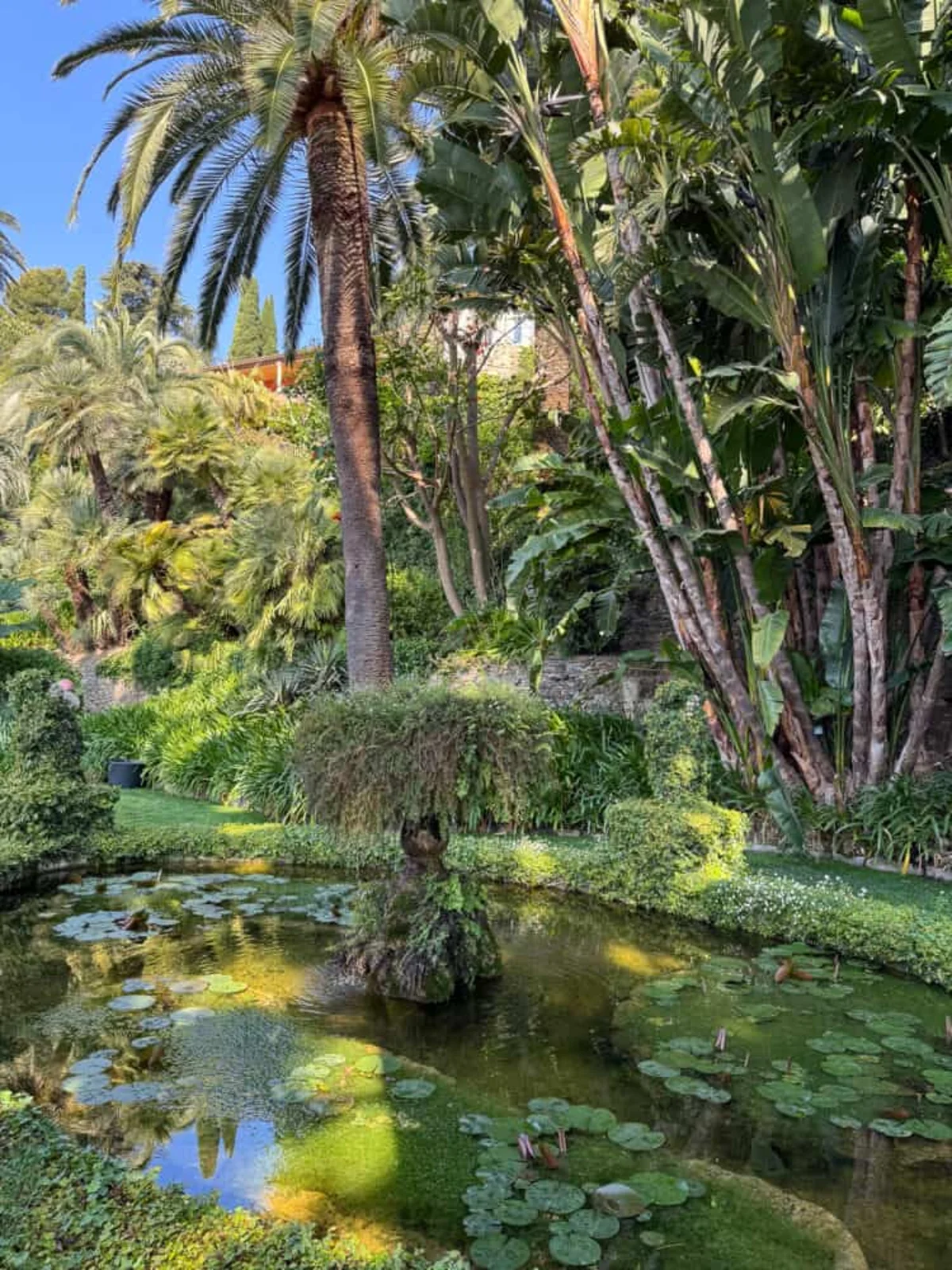
If you’re not staying at the hotel, the gardens are only open on guided tours: 80 minutes, €19 for adults, four times a day from spring to autumn. Ours ran in Italian, but the guide spoke English, translated the key facts, and handed us an English information sheet. Worth it if you like gardens, and book ahead on the Giardini di Villa della Pergola site. One practical note: it’s up a hill with no on-site parking, about a 10-minute walk from the train station, and there’s a useful shortcut underpass at Via Gibb 30. Wear real shoes — heels and flip-flops are banned.

Do nothing on the beach
The beach is 3km (1.9 miles) of sand with shallow, usually calm water, and unlike most Riviera beaches there’s no road running along it — just hotels, restaurants, and the beach clubs (bagni). In summer it’s rows of sun beds; in late April most clubs weren’t even set up yet. We had grey, empty mornings and one weekend when it was properly lively, with live music at the beachfront restaurants. Either way it’s the best long walk in town, and there’s a 16th-century defensive tower, Il Torrione Saraceno, sitting in the middle of the sand that makes a good halfway marker.

Stroll the Budello after dinner
Via XX Settembre is the narrow old-town shopping street that runs parallel to the sea. It’s called Il Budello — “the gut” — and it does what it says: shops, bakeries, gelaterias, and a window full of Baci di Alassio, the local chocolate-hazelnut biscuits that are basically a chewy macaron. We had ours from Il Fornaio. The street does its best work during the pre-dinner passeggiata, when everyone who lives here turns out for a lap and the whole thing glows. The historic Balzola cafe has these biscuits in its window if you want to see what you’re chasing.
Sign-check the Muretto
Opposite Caffè Roma, a 1950s artist hotspot where Hemingway was a regular, there’s a wall of colorful ceramic tiles covered in signatures. Hemingway signed in 1953; Louis Armstrong, Michael Schumacher, Eric Sykes, and a long list of famous Italians followed. There’s also a bronze sculpture called The Lovers. It takes five minutes. It’s charming. Do it on the way to a coffee.
Walk the promenade to Laigueglia
Laigueglia is the fishing village just south of Alassio, and the two towns are joined by a flat, pleasant promenade along the beach: about 45 minutes (3.5km / 2.2 miles) each way. In Alassio it starts near Marina Restaurant. Laigueglia is one of the Borghi Più Belli d’Italia, it was founded by the Romans, and its piazzas open straight onto the sea — a good place to stop for a drink, as we did at Maggie’s Bar & Bistrot by the beach. The other thing there is the Chiesa di San Matteo, an 18th-century Baroque church squeezed next to the train tracks. Approach it from the lane opposite (where Ristorante La Sosta is) and take the underpass under the rails to get your sense of its size. The train back isn’t frequent — every two hours when we were there — so we walked back along the water. Not a bad way to spend an afternoon.

Climb to Santa Croce for the view
Santa Croce is a tiny 11th-century Romanesque church on a hill above the town, built by Benedictine monks from Gallinara Island and reopened after centuries of neglect in the 1970s. The walk from Alassio station is about 2km (1.2 miles), 35 minutes: along the beach, then just past the Diana Grand Hotel you cross the tracks and climb the steep Strada Romana Santa Croce, another 15 minutes. There’s a longer alternative up the old mule track through Solva village, and an hourly bus 92 if you’d rather not climb — the IAT office has the timetable. The interior is a simple wooden-roofed shell, but the terrace below is the real prize: benches, pine trees, and the marina and Gallinara Island on one side, Alassio on the other. On a clear day you can see the mountains of Tuscany and Corsica.
Gallinara itself isn’t open to the public, but boat tours circle it with Mola Mola Dive Team — best in summer, when you can stop and snorkel.
Walk the Via Julia Augusta to Albenga
This is the one that surprised me. The Via Julia Augusta is a Roman road from 13 BCE, part of a bigger route from Rome to southern Gaul, and the section from Alassio to Albenga is walkable. It starts under a stone arch to the left of Santa Croce, so you’ll need the climb above first. After that it’s gently rolling: quiet road, stony dirt track, some original cobbles toward the end. The highlights are the sea views, the Mediterranean trees, the wildflowers, and a couple of old tombs along the way.
In Albenga you walk down the hill, cross the red bridge (Ponte Libero Emidio Viveri), and drop into a genuinely lovely medieval center — narrow lanes, piazzas, towers, and almost no one. We had lunch at Rattopenugo Bistrot on a piazza with cathedral views; it was good value. The cathedral’s baptistery has Byzantine mosaics for a small fee, though it was closed at lunchtime. We’d meant to eat at Puppo, the place known for its farinata, but you need a reservation.
Our route from the Alassio seafront to the Albenga center was 6.7km (4.2 miles) with 143m (469ft) of climbing, and took 1.5 hours. The Via Julia section itself is 4.5km (2.8 miles), just under an hour, with no facilities on the way, so carry water. Add 15 minutes from Alassio station to the seafront and 10 minutes from Albenga station to the center and it’s about 2 hours of walking station to station. Even if you skip the trail, the train to Albenga for an afternoon is worth it.
We followed the route on AllTrails (the GPX is on the Visit Alassio site, and we had a Plus membership for offline maps).
Hike to Torre di Vegliasco
The hills above Alassio have proper hiking, and it’s steep. We wanted something moderate and chose the loop from Alassio up to Torre di Vegliasco: 8km (5 miles), 430m (1,411ft) of gain, 2.5 hours including a break at the tower. It starts near Villa della Pergola with a very steep cobbled climb on an old mule track off Via Galliano. We climbed for about an hour past olive groves, with the sea behind us. Tough going, doable with short breaks. Up top there’s a mural of Italian presidents by street artist Robico, the small hamlet of Vegliasco (no amenities), and then the tower itself — a real Rapunzel-style stone tower from the 16th century. The descent was forest trail and more sea views. We didn’t meet another hiker until the very end, on a Saturday. It’s not a must-do, but it’s the quietest side of Alassio.
Without the map saved offline we’d have gotten lost — there are hidden turns. The Visit Alassio site has GPX data and a trekking leaflet is at the IAT.
Where to eat in Alassio
Everything below is in the center and walkable. Seafood is the main event here, so if you’re eating plant-based your choices are narrower — though pesto pasta is on every menu.
The easy stuff
- Bread Butter And Jam — the pastisserie-gelateria for brioche and coffee. It was my first stop most mornings.
- Il Fornaio — the bakery on the Budello. Big selection of focaccia, farinata (good but cold), and the Baci di Alassio. Quick snack or light lunch, but it closes 1–4pm.
- Pizza Al Volo — takeout pizza slices and farinata on the Budello. You can order a whole pizza, it’s good value, and eating it on a bench on the pier is a whole mood.
- Alberto Marchetti — excellent gelato on the Budello. The mango is the one to get.
Sit down
- Mani Pizza — seafront pizzeria with puffy crusts and odd, good toppings. The Bordighera pizza with vegetables and a yellow cherry tomato sauce was the highlight for us.
- Osteria Mezzaluna — a quirky place with a cave-like room and live music, or outside tables over the beach. It opens at 6pm, which is rare, and it had the best vegetarian menu we found: goat’s cheese salad, a platter of grilled vegetables and cheeses. I was hungry for it.
Two we didn’t make it to: Osteria I Matetti, traditional Ligurian food that looked great but is hard to get into without a reservation, and Nove, the Michelin-starred restaurant at Villa della Pergola. Nove has a vegetarian tasting menu at €200 per person, which is a splurge, but a splurge with a view.
Where to stay
We stayed at Casa d’Artista, a beachfront guesthouse with exactly three rooms, in a historic apartment full of art, books, and antiques. Our room had a sea view and no balcony, but there’s a shared living room with tables on a balcony right over the sand, and the waves from the room were the best part. There are chandeliers, model ships, and guns on the walls. I have never stayed anywhere like it. The location is the real reason to book it: 3 minutes to the train station, under a minute to the beach, on the main shopping street. The tradeoff is that you can hear the beach bars below — fine in April, loud in summer. Only two rooms have sea views, and it fills up, so book early.
Other options: Villa della Pergola itself, gorgeous and historic, up a hill with a pool — it was out of our budget. Grand Hotel Alassio, right on the beach with its own beach club and seafront-balcony rooms, which in summer is a serious advantage. Booking and Airbnb both have plenty of other choices.
How to get to Alassio
By plane, the nearest airport is Genova City Airport (GOA), about 1 hour 15 minutes by car or around 2 hours by bus plus train. We actually flew into Pisa (PSA), much further east, because we were also visiting Levanto for Cinque Terre and Camogli on the way. From France, Nice Côte d’Azur (NCE) is 115km (71 miles) west, about 1 hour 45 minutes by car.
By train, which is what I’d do: parking in town is hard and expensive, and the Intercity from Genoa to Alassio takes 1 hour 5 minutes. Book on Trenitalia — use the Italian name, Genova, not Genoa. Intercity beats the regional trains with luggage: seat you can reserve, more storage. First class is often only slightly more and worth it. Regional trains don’t need far-ahead booking (five minutes before departure is fine); the faster Freccia trains are cheaper if booked a few months out, which matters if you’re coming from elsewhere in Italy. I book everything in the Trenitalia app.
Heading on to France is easy: the Intercity from Alassio to Ventimiglia at the border takes 1 hour, then the French TER regional train to Nice Ville takes another. The TER stops at Monaco and runs on to Cannes, ending in Grasse. Book with the SNCF Connect app or buy tickets at Ventimiglia station. No advance booking needed for the TER.
The golden hour
One hour, one recommendation: the last hour of light on the Budello. The street lights come on, everyone is out for the passeggiata, the Balzola has its biscuit window glowing, and the sea is flat behind you. Buy a Bacio, walk both ways, sit down somewhere. That’s Alassio at its best — no itinerary required.
FAQ
How many days do I need in Alassio?
Two to three is plenty for the town itself: the gardens, the beach, the Budello, and the walk to Laigueglia. Add a fourth day for the Via Julia walk to Albenga or the Vegliasco tower hike.
Is Alassio good for a beach holiday?
In summer, yes — 3km of sand, shallow calm water, and a full beach-club scene, though expect crowds in July and August and book sun beds ahead. In spring it’s quieter and better for walking and the gardens.
Do I need a car?
No. The Intercity train from Genoa takes 1 hour 5 minutes, everything in town is walkable, and parking is the hard part. A car only helps if you’re exploring the hills beyond the marked trails.
Is Alassio worth visiting?
Yes — if you know what it is. It’s not the postcard Riviera. It’s the slower one: a beach town where the Italians go, where the gardens still grow what the British planted, and where a Roman road is still a walk. In summer it’s a proper beach destination with a lively restaurant scene. In spring it’s quiet, walkable, and the wisteria is absurd. I’d go back in April every year.
A note from Luna: the best trip I’ve made recently was the one where almost no one else was. Alassio was like that. I still think about the evening light on the beach, and the sound of it, more than any of the photos.
More from the coast: my Italian Riviera travel guide, and if you’re planning the wider region, the Finale Ligure guide — it’s only 30 minutes away.