
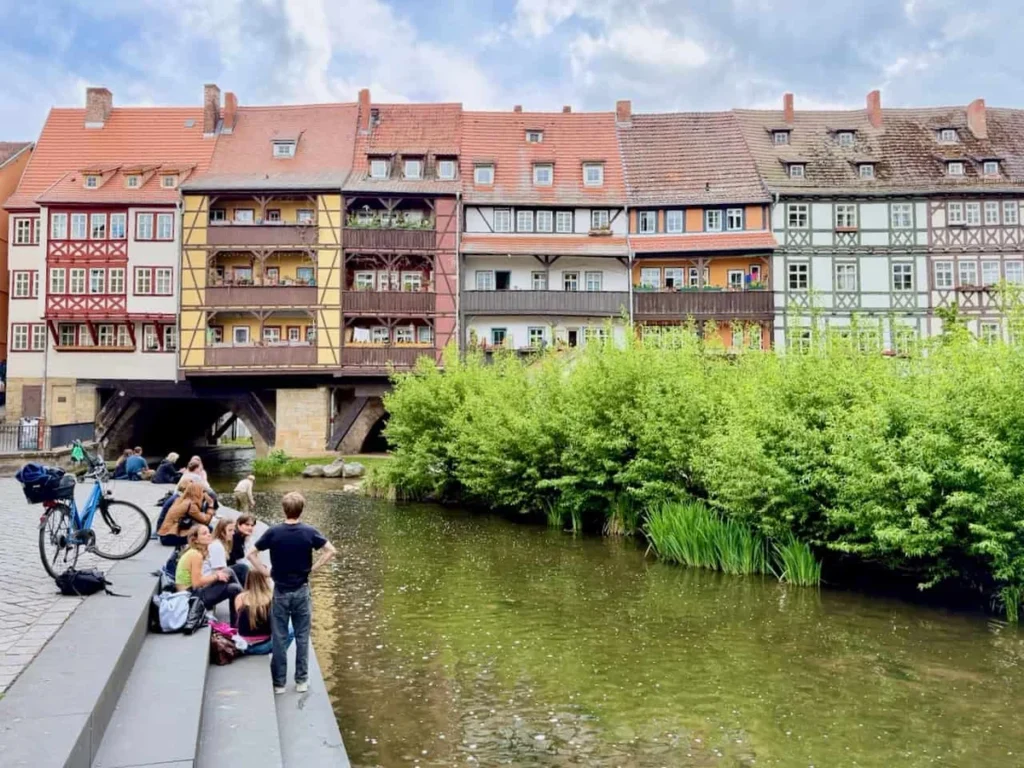
I arrived in Erfurt at dusk, camera over one shoulder, notebook full of nothing but the address of my hotel. One night, an early train the next morning. I should have left it at that. But the city kept showing me things — a bridge with houses on it, spires over a sea of terracotta rooftops, a lane so narrow I could touch both walls — and by the last hour I had already decided I was coming back.
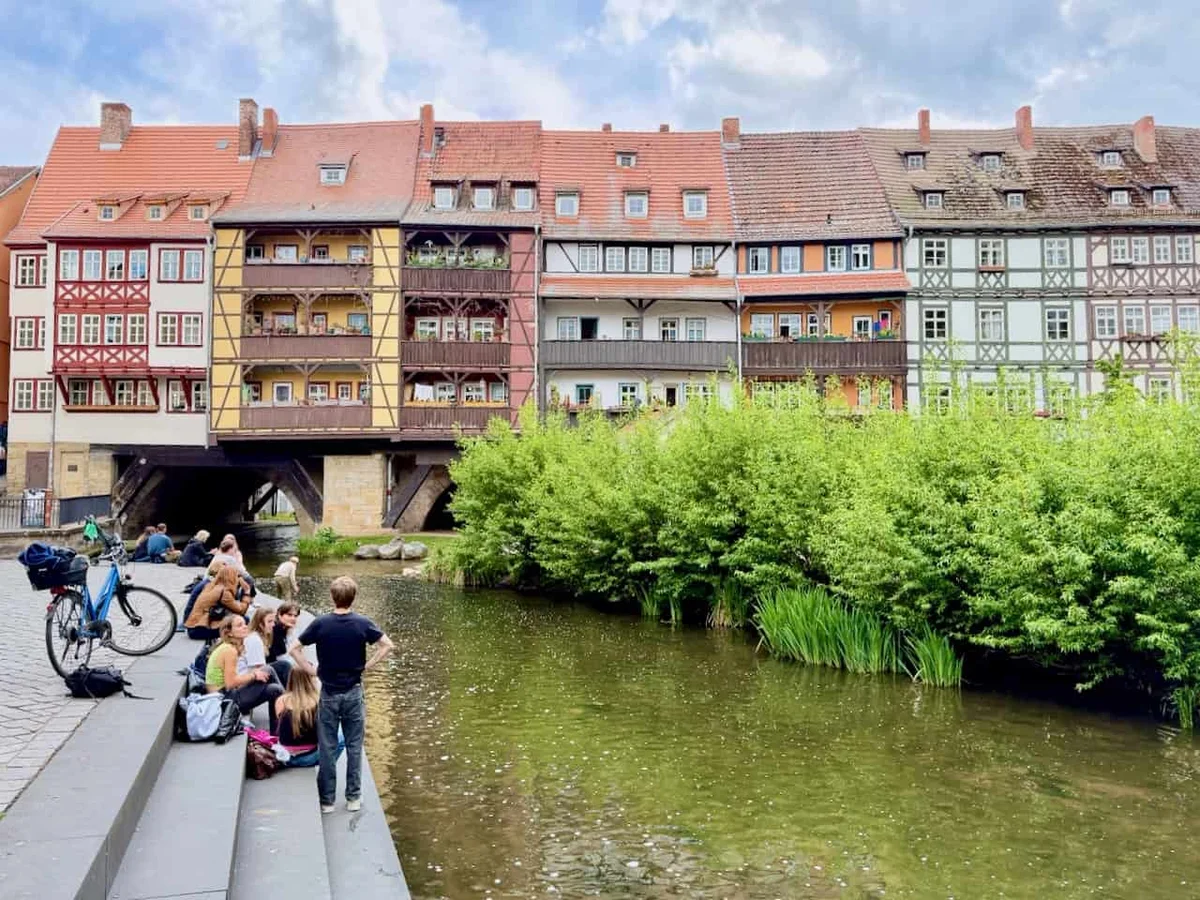
That decision is what this post is. Not a list of must-sees, but the actual route I walked, at a slow pace, with stops for coffee and sausage. Erfurt survived the war years largely intact, so the medieval old town is still a working place: students cycling past merchant houses, bakeries opening before nine. You can cover it in 1–2 days on foot, and you don’t need a map that isn’t built into your phone.
Before you start: a five-minute history
Erfurt is one of Germany’s oldest cities, first mentioned in the 1st century AD. For most of its life it made its money at crossroads, and in the Middle Ages it got rich on woad, the plant that made the blue dye half of Europe wanted. That trade paid for the churches and merchant houses you’ll walk past all morning. It was also a center of learning: the university was founded in 1379, and its most famous student, Martin Luther, spent his formative years here in the early 1500s. You’ll meet him twice on this route, once in a museum and once on a bridge he never crossed.
The walk, stop by stop
Everything below follows one continuous loop through the Altstadt. I’ve kept the order the way I actually walked it. Budget a full, unhurried day; the courtyards alone will eat your afternoon.
1. Domplatz
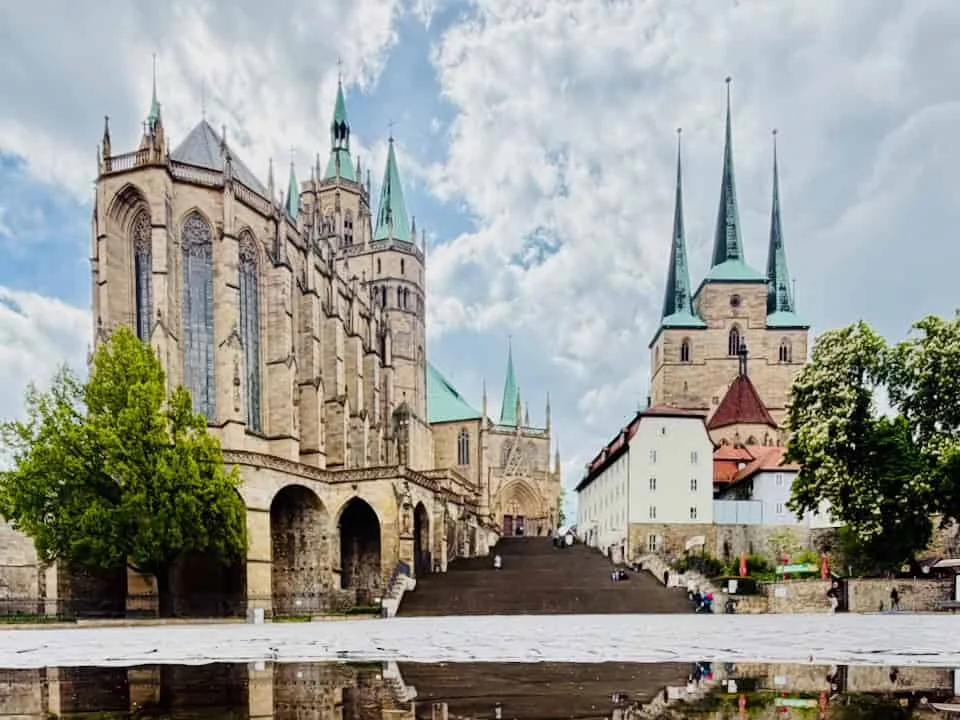
Start where the city’s oldest money was spent. Domplatz is one of Germany’s largest market squares, and it’s framed by the twin silhouettes of St. Mary’s Cathedral and St. Severus Church. Step inside the cathedral for the stained glass and the Gloriosa, the world’s largest free-swinging medieval bell, cast in 1497. Then sit on the cathedral steps for ten minutes. On market days the square fills with produce, flowers and regional food, and the view from the top of the staircase is the best free postcard in the city.
2. The Andreasstrasse Memorial
A stone’s throw from Domplatz is a quieter, heavier stop. The Andreasstrasse Memorial is housed in a former prison used by the Nazis and later by the Stasi. Testimonies, preserved cells and multimedia exhibits document what political prisoners lived through under both regimes. It’s short, and it’s worth it, because the medieval story and this one are the same story in different centuries.
3. Haus zum Sonneborn
One of the old merchant houses worth pausing for. The story isn’t certain — a merchant’s residence, a woad warehouse, or a brewery at some point. The two holes above the entrance are the clue: supposedly a bundle of grain dropped through when fresh beer was ready. Now a wedding venue, it’s a good reminder that this old town was built on commerce, not tourism.
4. Rathaus on Fischmarkt
The neo-Gothic city hall was built in the late 19th century, and it shows the confidence a prosperous city had in itself. Inside: a grand staircase and murals depicting Thuringian history, including scenes from Luther’s life. Even if you don’t go in, the building makes a proper backdrop for a coffee at one of the Fischmarkt cafés. Sit on the terrace. Watch the square do its thing.
5. Dämmchen and the Krämerbrücke
The River Gera threads through the old town, and the Dämmchen is the best stretch to walk along it. A narrow pedestrian path beside the water, half-timbered houses on one side, their reflections doing the work of a postcard on the other. It’s also the best vantage point for the Krämerbrücke itself.

6. The Krämerbrücke
The reason most people photograph Erfurt, and the reason I came back. The Merchants’ Bridge spans the Gera, and it’s lined on both sides with preserved half-timbered houses. Originally built in stone in 1325, it’s the longest continuously inhabited bridge in Europe. First visit, I searched for it and realized I was standing on it. Browse the independent shops, then buy something from Goldhelm Schokolade, one of the businesses that has grown into a local institution. The Krämerbrücke truffels are the ones I’d carry home.
7. Augustiner Monastery
This is where Luther’s story turns personal. After enrolling at the University of Erfurt in 1501 and studying law, a thunderstorm near the city broke something open in him; he vowed to become a monk if he survived the next bolt. He entered the Augustinian monastery in 1505 and lived here for several years. The tour moves through the rooms where he studied, with exhibits on his life and the beginnings of the Reformation. If you’re the kind of person who follows a historical figure through their formative years, this is the stop that earns its place on the route.
8. The Old Synagogue
One of the oldest synagogues in Europe, dating to the 12th century, and for centuries it was simply a building that had been used as a restaurant and party venue before its original purpose was uncovered in the 1990s. Now it’s a museum of Erfurt’s medieval Jewish community, and the centerpiece is the Erfurt Treasure: gold coins, silverware and jewelry hidden during the 14th century and found again centuries later. The gold ring they display is the piece I kept thinking about on the walk back to the bridge.
9. Schlösserbrücke
The lesser-known bridge, and a better place to stand and do nothing. A historic stone bridge over the Gera, with views of the waterways that once powered mills and carried trade through the city. Less crowded than the Krämerbrücke, and the quiet is part of the point.
10. Petersberg Citadel
End the day with a view. The Petersberg Citadel is one of Europe’s largest preserved Baroque fortresses, built on the site of a medieval Benedictine monastery and strengthened by Napoleon in the 19th century. The ramparts give you cathedral spires, medieval rooftops and the Thuringian countryside in one frame. Underground there are tunnels and bastions with centuries of military history if you want a second lap.

Don’t skip: the hidden courtyards
The courtyards are the reason I keep saying Erfurt rewards slow exploration. Many merchant houses open through unassuming archways onto quiet gardens, small cafés, artisan workshops and beer gardens. You won’t find a map of them. You find them by wandering, the way you find a good corner in any old town you’ve given time to.
Where to eat and drink
Erfurt has the kind of café culture where the square itself is the room. Regional Thuringian food is worth a proper sitting: the Thüringer Rostbratwurst at the stall and beer garden at the foot of St. Severus Church is the standard after a day on your feet. For a longer meal, I’d start with Platzhirsch (Wenigemarkt 10, near the Krämerbrücke), Zum Güldenen Rade (Markstrasse 50, near the Rathaus) or Wirtshaus am Dom (Domplatz 12). For coffee and cake, Goldhelm Schokolade Café on Kreuzgasse, near the Dämmchen, is the easy answer.
One more street if you have time: Anger, the shopping street between the old town and the station. The buildings there are a different style book, including some genuine Art Nouveau gems, and it’s a pleasant walk back toward the train.
The Golden Hour
6:30 p.m. on Domplatz, late spring. The light goes long and amber across the square, the market is packing up, and the twin spires sit in the last of the warmth. Ten minutes on the cathedral steps. That’s the hour I’d give you.
FAQ
How long do I need for Erfurt?
1–2 nights is the right amount. The old town is compact enough to walk in a day if you’re in a hurry, but the courtyards and the citadel want a second afternoon.
How do I get to Erfurt?
It’s less than 2 hours by train from Berlin and about 2.5 hours from Frankfurt. No airport needed for most people.
Where should I stay?
Staying in the old town makes the whole walk simpler. I stayed at the Dorint Hotel am Dom, a business hotel with spacious rooms opposite the Erfurt Theatre. A warm alternative is the family-owned Hotel Domizil on Domplatz, with beautiful rooms and a proper breakfast.
A note from Luna
Erfurt never announced itself. It just let you walk until the city showed up, and by then it was too late to leave without a second trip in the notebook.
Affiliate note: some links in this post may be affiliate links; if you book or buy through them I may earn a small commission at no extra cost to you.