
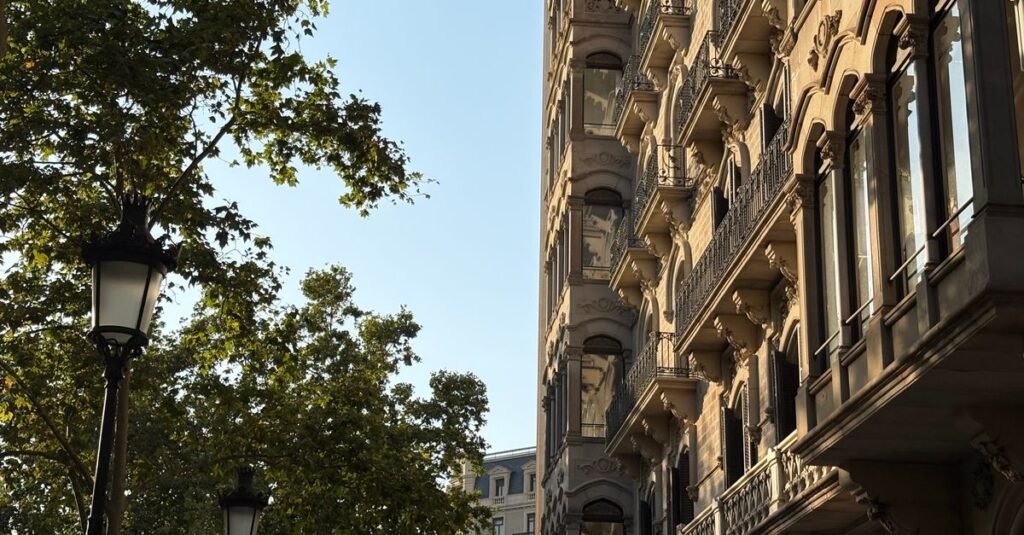
The city was loud when I arrived, the way it always is. But by the second evening I had started taking the long way everywhere, and that is when Barcelona began to open up. The famous landmarks are worth seeing, no argument. But after a while the crowds around the Sagrada Família and the Ramblas wear you down, and the quieter corners start to feel like the real reason you came.
These are the places I keep on my Barcelona list. None of them are perfectly secret anymore, but most of them are still far quieter than the city’s famous sights. I would not try to do all of them in one day. Pick two or three that fit you and slip them around the places you already plan to see.
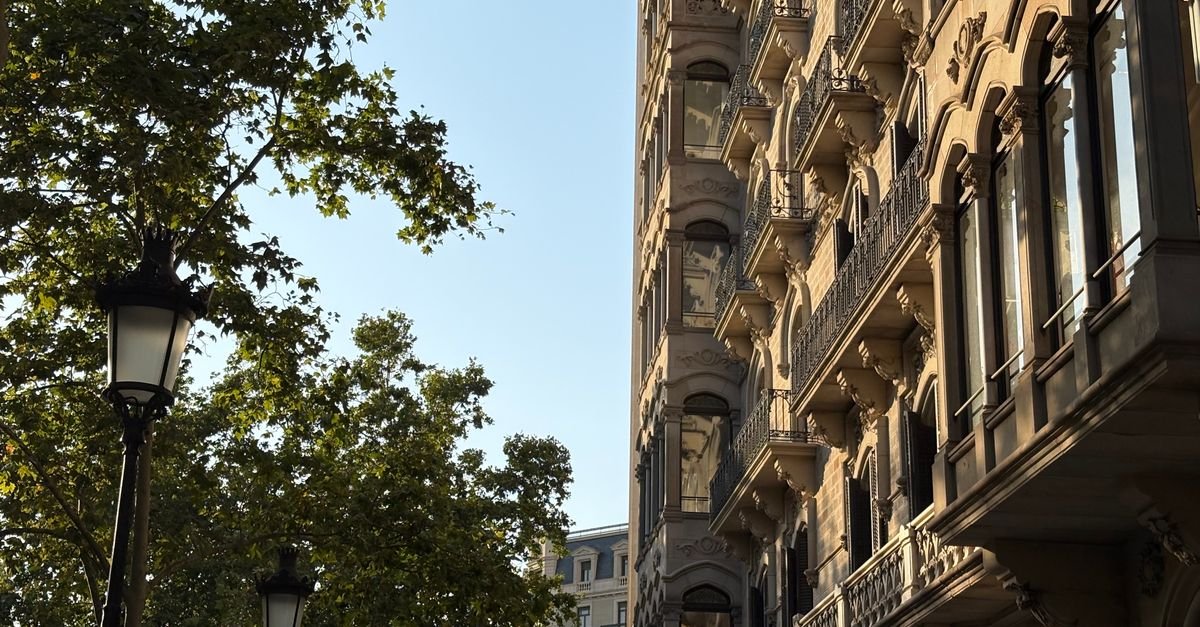
Palau Dalmases: the palace behind an unremarkable door
I missed this the first time through. I was on my way to the Picasso Museum and walked straight past a street I would later spend an hour on. Carrer de Montcada is the kind of street you don’t look twice at, but number 20 is worth the stop. Behind a wooden door is Palau Dalmases, a Baroque palace from the 17th century that most visitors never notice.
It was built between 1673 and 1680 for the Dalmases family, one of Barcelona’s noble houses. From the street it looks almost ordinary. Step inside the courtyard and you see why people stop. The staircase is the thing to look at — the carved stone reliefs with mythological figures, sea horses, and the Triumph of Neptune.
For most of its life it was a private residence, completely closed to outsiders. Later it became home to the Omnium Cultural, an important Catalan cultural institution, and today it hosts intimate flamenco shows in the evenings. The audience is small, but the candlelit atmosphere and the dancing itself are the kind of thing you don’t get anywhere else. If you stop by, stay for a show if you can.
Bunkers del Carmel: the view most people never take the time for
If you want a view of the whole city, you don’t have to queue for the hilltop attractions. Take the L4 metro to Alfons X, walk uphill through El Carmel, and twenty minutes later you are standing on Turó de la Rovira, atop the crumbling remains of a Spanish Civil War anti-aircraft battery.
There are no ticket booths, no audio guides, no gift shops. Just the ruins, the wind, and the view, which stretches from the Sagrada Família to the Mediterranean to Camp Nou in a single slow turn. The city unfolds below you like a map. Early in the morning the light is extraordinary and the other people there are few.
One practical note: as of 2026 the site runs on a set schedule, open 9 am to 7:30 pm in summer and 9 am to 5:30 pm in winter. Plan around it, because once the gates close, you are walking back down in the dark.
Gràcia: the village that refused to become a city
Barri de Gràcia is the neighborhood I would send someone to if they only had one evening in Barcelona. On a warm night, Plaça de la Virreina and Plaça del Sol fill with locals at the outdoor tables, each with a caña, a small cold draft beer. Kids run between the café chairs. Old men play cards. There are no tour buses, and no English menus posted in the windows to pull you in.
Instead you get independent bookshops, a cat café, and a dozen restaurants where the menu changes daily with whatever came in from the market that morning.
It has a history that explains the feeling. Until the late 1800s, Gràcia was its own borough, with its own authorities. When Barcelona grew outward, the village was absorbed into the city over the fierce protest of its residents. More than a century later, that independence is still in the cobblestoned streets and the sun-drenched squares. It does not feel like the rest of the city. It feels like somewhere else entirely.
Time your visit for August if you can, for the Festa Major de Gràcia, one of the most authentic street festivals in Spain. Every street competes to build the most elaborate decorations, kilometers of hand-made paper flowers and ocean scenes and jungle canopies of recycled materials, all strung overhead above the alleys. Nothing with a ticket price replicates it.
Getting there is easy: metro L3 from Liceu or Catalunya, heading north to Diagonal, or walk along Passeig de Gràcia and continue north on foot. The area sits about 2–3 km north of the top of the Ramblas, at Plaça de Catalunya.
Casa Vicens: where Gaudí began
Take the metro a few stops north from Passeig de Gràcia, walk to Carrer de les Carolines 20, and you will find a building most tourists have never heard of. Casa Vicens was Gaudí’s first commission, completed between 1883 and 1885 when he was 31 years old. It came before the Sagrada Família, before Casa Batlló, before Casa Milà. This is where the obsession started, and it is the first Gaudí I visit now, before anything else.
It looks nothing like what you expect from him. No flowing organic curves, no bone-white towers. The facade is covered in green-and-white ceramic panels inspired by the marigolds that used to grow on the site. When the flowers were cleared away to make room for the building, Gaudí put them on the walls instead. The Moorish and Orientalist influence is all over it: ornate brickwork, decorative arches, intricate tile patterns.
Look at the wrought-iron fence too. Those palm-leaf motifs were among the first expressions of his lifelong belief that buildings should grow from the earth rather than be imposed on it. The house only opened to the public in 2017, which is why the crowds have not caught up. Go here first, and the rest of his work makes more sense afterwards.
Recinte Modernista de Sant Pau: a masterpiece with room to breathe
Few visitors find this one by accident, which means you have an edge if you know where to look. Walk down Avinguda de Gaudí from the Sagrada Família and at the far end of the boulevard you reach a building that is ornate and strangely quiet. This is the Recinte Modernista de Sant Pau, a UNESCO World Heritage Site and, by many architects’ reckoning, the finest Art Nouveau complex in the world. The crowds that swarm the Sagrada Família every morning rarely make this walk, so most of the time the place sits nearly empty.
It is at Carrer de Sant Antoni Maria Claret 167, and it was designed by Lluís Domènech i Montaner, a great figure of Catalan Modernisme. The ensemble is forty-eight buildings and gardens spread across a large area, and every surface is covered in mosaics, stained glass, carved stone, and sculpture.
It worked as a hospital until 2009, on the founders’ idea that beauty itself was part of the cure. The 20th-century design eventually became impractical and too costly to maintain, and the hospital moved to a newer complex at the northern edge of the site. Now you can wander the grounds for hours, moving from pavilion to pavilion, reading the stories carved above the doorways. Compared to the packed attractions in the center, the space and the silence are the point, and I kept wanting more of both.
Poblenou: the factory quarter that became somewhere else
Rambla del Poblenou reminded me of the Ramblas without the crowds. The same tree-lined walkway, the same café terraces, but it reads as a neighborhood street where people actually live, not a strip built for visitors.
Poblenou spent decades as a working-class factory district and got left behind when the factories closed. Over the past twenty years it changed a lot, and it is now one of the more interesting corners of the city to walk. The street art rivals what you see in Berlin or East London: murals four stories tall on the sides of converted warehouses, with new pieces appearing every few months. And it still feels lived-in, not staged.
For dinner, try Els Tres Porquets at Rambla del Poblenou 165. It is a casual tapas place with a seasonal menu on a chalkboard, and it feels local in a way most restaurants near the tourist areas do not. The croquetas are a good choice, and it is worth asking what the daily specials are.
The neighborhood is close to the beach, which makes it a good place to be later in the day. The beach there is usually quieter than Barceloneta and feels a little more relaxed, the kind of evening that ends with a slow walk home.
Parc del Laberint d’Horta: the maze on the hillside
Parc del Laberint d’Horta sits in the Horta-Guinardó district, away from the main tourist areas. It takes a little more effort to get there, which is probably why it stays quiet.
The park dates back to 1791 and was originally designed for a Catalan noble family. It is laid out on a hillside, with terraced gardens, fountains, shaded paths, and the hedge maze that gives it its name. The walls are tall cypress, high enough to take your sense of direction for a few minutes at a time. I found it fun as an adult, and I can only imagine what children make of it. Entry costs only €2.23, which makes it one of the cheapest places in the city.
I went on a weekday morning and the park was almost empty, a few people walking through the gardens, someone sitting on a bench. After several days in the busy center, that felt like exactly what I needed: a place to slow down and stop hearing the traffic for an hour.
The golden hour
My favorite hour in Barcelona is the one right after the afternoon heat breaks. The light goes soft and golden over the old town, the cafés fill up, and the city shifts from tourist mode to resident mode. If you can, spend it in Gràcia with a caña at one of the square tables, or up at the Bunkers del Carmel if you went in the morning. Either way, that is the hour when the city feels like it belongs to the people walking it, not the people photographing it.
A few questions I get asked
Do I need a full day for these? No. Two or three of them around the landmarks you already plan to see is the right amount. The maze park and the bunkers are both easy morning additions.
Are any of these expensive? Most are free. The only one with a cost I can confirm is Parc del Laberint d’Horta at €2.23, which is about as cheap as it gets in Barcelona. The flamenco shows at Palau Dalmases and tickets at Casa Vicens and Sant Pau are separate, so check the current prices before you go.
What if I only have one quiet evening? Gràcia. The squares, the bookshops, the dinner somewhere the menu changes daily. It is the best single evening the city offers that does not feel like sightseeing.
Barcelona’s famous side is worth your first days. But the quiet side is what I think about when I plan the next trip. These places did not make the city feel smaller or less overwhelming. They made it feel personal, in the way a neighborhood does. A few of them are on my list again for next spring, and I have already told myself to take the long way there.
A note from Luna: not every trip is perfect, and some nights you are waiting out the dark at a station. But Barcelona has a way of making the detours feel like the point. I keep coming back to the streets I almost walked past.