
The night train into Marrakech pulls in while the city is still half asleep, and the medina smells like woodsmoke and orange blossom. I have written about trips that fell apart — I once booked a ‘quiet hotel’ directly above a nightclub — so when a route this long actually works, it is worth writing down properly. That is what this is: two weeks I just got back from, mapped stop by stop, with the parts you can cut if you only have 10 or 12 days.

Here is the shape of it at a glance:
- 14 days: Marrakech → High Atlas trek (5 days) → Dadès Gorge → Merzouga → Fes → Casablanca
- 12 days: same route, minus the first two days of the trek
- 10 days: 12 days minus one night in the Sahara and the Casablanca stop
- Not a hiker: swap the Atlas days for a 3-hour detour to Essaouira
Budget note, since I get asked: my whole 2-week trip cost about $2,200 — private driver, guides, muleteer, accommodation, meals, tips, a cooking class, souvenirs. You can eat well for $15 a meal and sleep somewhere decent for under $80 a night.
The route, stop by stop
Marrakech (2 nights)
Marrakech is the Red City — the walls are the color of old clay, and the medina inside them dates back to 1070. Walk it first. The alleys lead you straight to Jemaa el-Fnaa, the big square, which is loud and chaotic and genuinely fun. Then go up to a rooftop, order mint tea, and just watch it move.
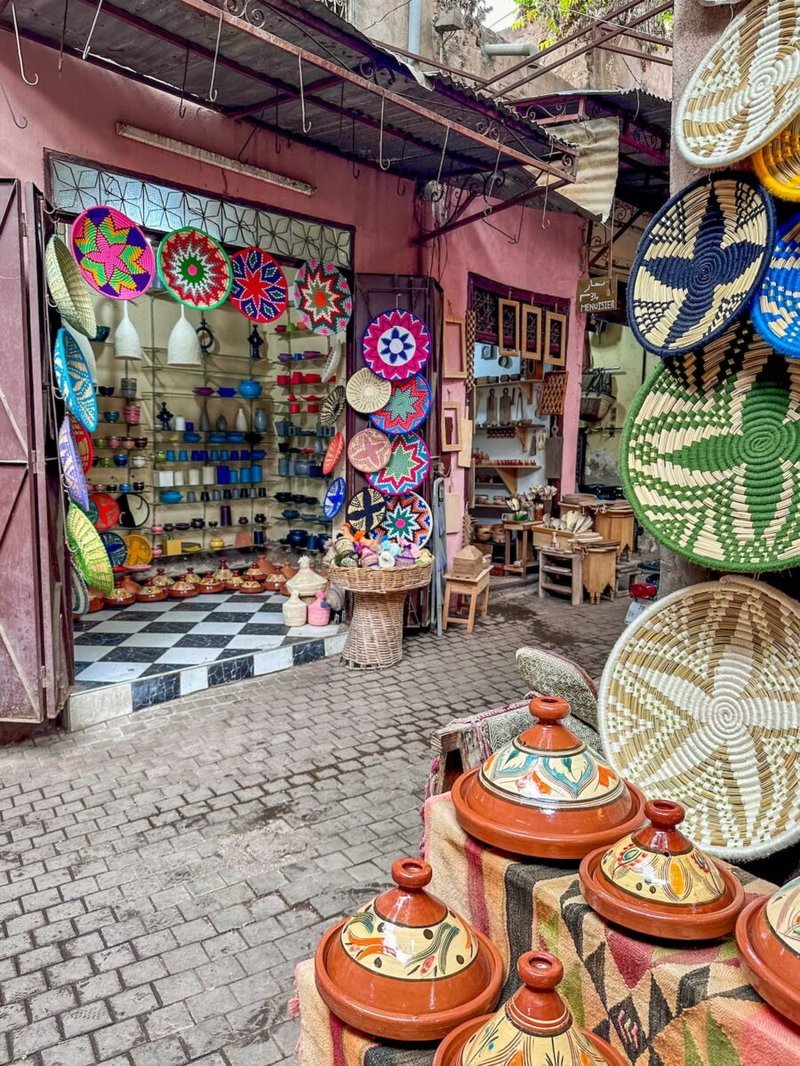
Things worth your time:
- The Bahia Palace — late 19th-century tilework and painted ceilings; the fastest way in if you are short on time
- Ben Youssef Madrasa — the largest Islamic college in North Africa in its day, up to 800 students; the carved upper levels have a view over the courtyard
- Jardin Majorelle and the Yves Saint Laurent Museum — book ahead, it sells out
- Le Jardin Secret — a smaller 16th-century palace garden right in the medina, no booking needed
Two small museums I would not skip: the House of Photography (80 MAD, historical photos from 1870 to 1950) and the Museum of Moroccan Elegance (50 MAD, 200 miniature costumes and a rooftop with a view).
On food: the Jemaa el-Fnaa stalls are the value play — I had vegetable couscous at Chez Hassan, stall 47, and it was some of the best food of the trip. Dabachi Chez Cherif is good for tagine and harira with a view of the medina. If you want to go up, L’mida on the roof serves modern Moroccan fusion with Atlas views.

Stay in the medina, not outside it. I split my two nights between Riad Dar Tiflet (about a 10-minute walk to the square, lovely rooftop) and Riad Hilmuna (closer to the airport and Majorelle, indoor pool, spa). Both include breakfast and can arrange transfers.
Getting into the mountains
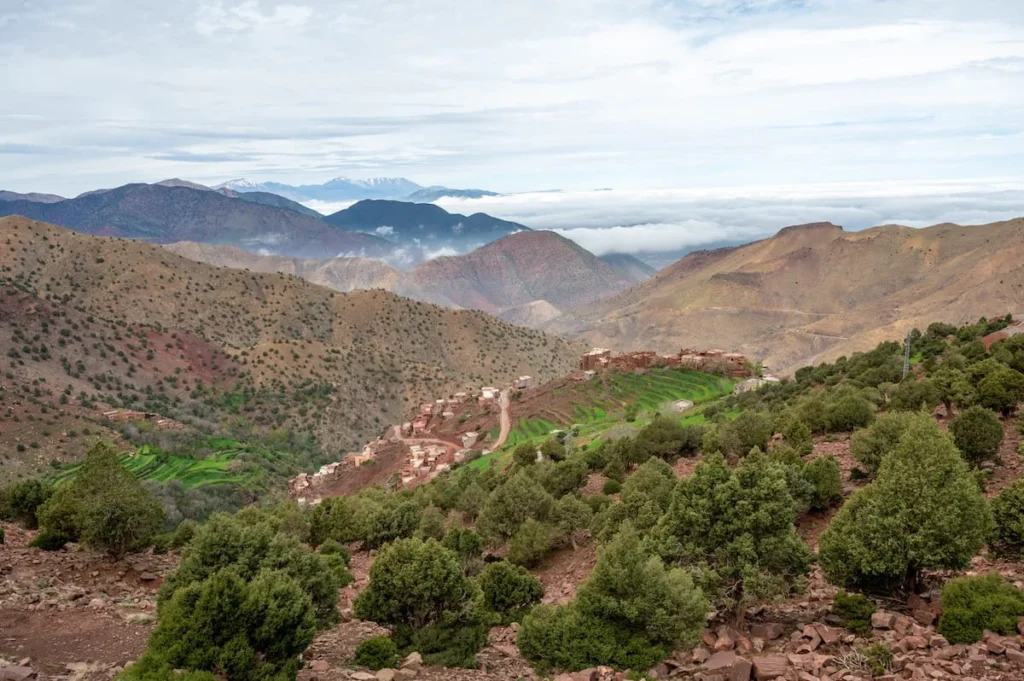
The drive from Marrakech to Ait Hani, the start of the trek, is about 90 minutes of olive groves and Berber villages. Stop at the Cooperative Feminine Aldayne — local women make argan oil there, and the honey and almond spreads with mint tea make a proper mountain breakfast. Then you meet your guide, a mule, and the muleteer who carries your bag.
A note on how to do this: I hired a private driver for the whole trip through Toubkal Guide, which organized the trek, guides, permits, and most of the logistics. For two people it ran $1,800 per person, and it was worth every dirham — though a lot of it is doable on your own if you prefer. One rule is non-negotiable: you need a guide to summit Toubkal.
Days 2–6: the five-day High Atlas circuit
This is the heart of the itinerary, and the reason to take the 5-day version instead of the 2-day shortcut. Day one climbs from 1,600 to 2,130 meters through a valley so green it looks invented — wild irises, butterflies, waterfalls. It is a moderate 5 to 6 hours of walking. Sleep at Gite Atlas Imzoughe, a simple clean guesthouse in a Berber village with hot showers and a terrace over the terraced fields.
Day two is the hardest climbing day: 870 meters of gain, about 5 hours. The trail runs in line with the clouds over the Ousertik Valley, passes the highest ski resort in Africa at 2,600 meters, and ends on a zig-zag into the Addi Pass at 3,000 meters. The descent through the Imnane Valley is 2 hours of loose rock — wear boots with real ankle support and size up a half-size. Night at Riad imNane Lodge.
Day three drops into Imlil, a proper mountain town with gear shops, ATMs, and restaurants, where you rest and plan the summit. Day four climbs 1,406 meters to the Toubkal Refuge at 3,206 meters. The refuge is a stone hut, dorms sleep 12 to 27 people (bring earplugs), and the lights go off for the day. Expect to wake between 2 and 4 a.m.
Day five is the summit. 4,167 meters — the highest point in North Africa. You start in the dark with headlamps, cross snowfields, and by sunrise the peaks around you catch color. The last 45 minutes of rock to the top is worth every step, and the descent is harder than the climb. Slide down the snow sections. It is the highlight of the whole trip and I will not argue otherwise.
Dadès Gorge (1 night)
Back in the car, about 6.5 hours to the gorge, and the landscape keeps changing: the Tizi n’Tichka Pass at 2,260 meters, then cactus plains, then mud-brick towns. Stops worth the time: Ait Ben Haddou, the 11th-century ksar that has doubled in films from Gladiator to Game of Thrones; Ouarzazate, the movie town; and the Valley of the Roses near Skoura, where the air smells of flowers and the shops sell rose soaps and oils.
In the gorge itself: the Monkey Fingers viewpoint, a moderate 5.2-mile canyon loop, and the best mint tea you will have on a terrace over red sandstone. I stayed at Riad Villa Dades, built into the rock with a pool rooftop and a candlelit dinner. Splurge money, but it is the kind of night that makes the whole route feel balanced.
Merzouga, the Sahara (2 nights)
Merzouga is where the roads end and the dunes begin — they rise to 150 meters and the whole place looks like Mars. The drive in is about 4 hours; stop at the Todra Gorge, where climbers work the limestone walls and nomads come down to the river, and at the Women’s Carpet Association of Todra Valley, run by 25 local families weaving with natural dyes. It is the most authentic rug place I saw in the country, and you will never find it without your driver.
Do two things well: climb a dune at sunrise, when the light is orange and you have it to yourself, and sit by the campfire at night to Berber music. I stayed at Sanmao Desert Luxury Camp — clean tents, hot showers, proper multi-course dinners. On camels: I did one, and I have watched enough camels in rough shape to now research the operator carefully before I trust one again. Same with 4×4 tours — they are fast, but they erode the dunes and wake everyone within a kilometer.
Fes (2 nights)
Fes is the oldest of the imperial cities. Its medina is a UNESCO site with 9,000 alleys, no cars, and a university that has run continuously since the 9th century. The sensory overload is real: fresh bread, spice stalls, leather, then something pungent, then wedding dresses. Go with a guide at least for the Chouara tannery — 11th-century methods, workers standing knee-deep in dyes, and guides keep the ‘free tour’ salesmen at bay.
Do the Blue Gate at first light if you can. The madrasa Bou Inania is gorgeous for 20 MAD. And the best thing I did in Fes: a souk tour and home cooking class. You shop the produce souks, then chop and simmer for an hour and eat what you made. I made tagine taktouka and I have been thinking about it for weeks.
Eat at Restaurant Dar Tresor on the rooftop — the vegetable couscous with sweet raisins was the best plate of the whole trip — or L’Amandier at Palais Faraj if you want to go up. Stay at Riad Dar Medina Fes in the quiet Ziat neighborhood; the rooftop breakfast was the reason I booked two nights instead of one.
Casablanca (1 night)
One night, no pressure. Hassan II Mosque is the anchor — the 210-meter minaret, the retractable roof, guided tours only. Walk the Corniche at sunset and watch the Atlantic come in against the mosque. If you have appetite left, Rick’s Café does 1940s decor and live jazz, and Dar Dada does a live-music dinner that goes well beyond tagine and couscous. Sleep somewhere near the Gauthier district — I stayed at Art Palace Suites & Spa, and ended the trip with a hammam, which felt exactly right.
Trimming the route
Twelve days: drop the first two days of the trek (Ousertik and Imnane Valleys) and drive straight to Imlil. Ten days: also cut one night in the Sahara and skip Casablanca — book a late flight and allow the 3.5-hour drive from Fes to Mohammed V International Airport.
No hiking? Swap the five Atlas days for Essaouira, three hours from Marrakech: a relaxed medina, good seafood, Atlantic light, and kitesurfers. The rest of the route stays the same.
Practical notes, from a notebook
- Getting around: the ONCF train connects the big cities but reviews say it is uncomfortable; CTM and Supratours buses are the comfortable option for places like Essaouira. There is no Uber — use InDrive. For this route, a private driver is the move.
- Water: skip the tap. Bottles run about 10 MAD everywhere, or carry a filter bottle like the LifeStraw Go if the plastic bugs you.
- Cash: my debit card did not work once. I brought $300 in cash and it was enough. Many places, including hotel restaurants, do not take cards.
- Tipping: 10% at restaurants, 10 to 20 MAD per bag for porters, 10% for guides, 100 to 200 MAD a day for a multi-day driver.
- Dress: cover shoulders and knees. A long skirt and a simple t-shirt carried me through the whole trip.
- Insurance: get it. SafetyWing is the one I use, and if you are summiting Toubkal, add the adventure sports rider.
Scams that actually happened to people I know
The medinas run on small cons. ‘The road is closed, come this way’ — keep walking. The free guide who wants a tip at the end — he is not free. The henna artist who grabs your hand without asking — have your no ready. The monkey or snake on your shoulder for a photo — it costs. And the free tannery tour that ends in an aggressive 200 MAD demand — that one happened to a friend of mine, and she paid to be out of it. I do not blame her.
The Golden Hour
The one hour I would build a day around: sunrise over the Merzouga dunes. Everyone goes out at sunset, which is fine, but at sunrise the sand is the color of apricots and there is nobody there. Bring the camera. Bring a thermos.
Questions people actually ask
How many days do I need in Morocco?
Ten to 14 days is the real minimum to do it properly. I had two weeks and I still came home with a list of things I missed.
Is it safe for a woman traveling alone?
I felt safe in the big cities and in the villages, day and night. Morocco is one of the more comfortable solo routes for a woman if you keep the usual slow-travel habits: check reviews, keep cash on you, dress with your shoulders and knees covered.
Is Morocco expensive?
Not really. Filling meals for $15, accommodation under $80 a night. My total for two weeks was about $2,200 with a private driver and guides included. It is one of the best-value serious routes I have done.
What is a riad, and how is it different from a dar?
A riad is a traditional Moroccan house built around an interior courtyard, often with a fountain or citrus trees. A dar is smaller, centered on a tiled courtyard without the garden. In practice people use the words interchangeably, and both are worth sleeping in at least once.
A note from Luna: Morocco is not a perfect trip. There were nights with bad coffee and mornings I was too tired to be a person. But the medina at dusk, the clouds at the Addi Pass, and the quiet orange of the dunes at first light — that is what you are going there for. Leave yourself a day to get lost.